 Allium ursinum) leaves and flowers" class="article-hero-image" alt="Wild edible plant guide" loading="lazy">
How to Tell Wild Garlic from Lily of the Valley: Complete Safety Guide
2026-05-15
CRITICAL WARNING: Lily of the valley (Convallaria majalis) is a highly toxic plant. It contains cardiac glycosides that can cause nausea, vomiting, cardiac arrhythmias, and in severe cases, death. Never forage any plant unless you are 100% certain of its identity. When in doubt, don't pick.
Table of Contents
- Why it's essential to tell these two plants apart
- Botanical description: Wild Garlic (Allium ursinum)
- The dangerous lookalike: Lily of the Valley (Convallaria majalis)
- Comparison table: 7 key differences
- Step-by-step guide: identification in 5 minutes
- Most common beginner mistakes
- What to do if you're unsure
- Where and when to find wild garlic
1. Why It's Essential to Tell Them Apart
Every spring, across Europe, cases of poisoning occur from confusing wild garlic with lily of the valley. The two plants grow in the same habitats (shady, moist woodlands), during the same period (March-May), and at first glance the leaves can look similar to an untrained eye.
The difference, however, is simple once you know what to look for: the smell.
Wild garlic (Allium ursinum), also known as ramson or bear's garlic, is one of the most valuable wild edible plants in Europe. Rich in vitamin C, allicin, and sulfur compounds, it has been used in European cuisine for centuries. Lily of the valley (Convallaria majalis), on the other hand, is a beautiful ornamental plant but potentially lethal — every part of the plant, from leaves to flowers to red berries, contains cardiac toxins.
This guide will teach you to tell them apart with certainty, using the most reliable method: the smell test, supported by other visual characteristics that will give you complete confidence.
2. Botanical Description: Wild Garlic (Allium ursinum)
Leaves
- Shape: Lanceolate (lance-shaped), broad, with a pointed tip. They grow singly from the base, not in pairs.
- Color: Bright light green, almost glossy when young. Darker with maturity.
- Size: 10-25 cm long, 3-7 cm wide.
- Texture: Smooth, soft, slightly fleshy. They bend easily without breaking.
- Smell: VERY STRONG garlic smell when crushed or rubbed. This is the most infallible sign. The smell is perceptible even by bringing your nose close to an intact leaf.
- Venation: Leaves have a visible central vein running parallel, typical of Liliaceae (now Alliaceae).
Flowers
- Shape: White 6-petaled stars, small (1-2 cm diameter), gathered in umbels (umbrella-like inflorescences) at the tip of a bare stem.
- Color: Pure white.
- Flowering period: April-May (later at higher altitudes).
- Number per plant: Each plant produces a single flower stalk with 10-25 flowers.
Roots/Bulbs
- Appearance: Elongated white bulb (1-2 cm), wrapped in a thin membrane. Grows 5-15 cm deep in the soil.
- Smell: The bulb also has a strong garlic smell.
Stem
- Height: 15-40 cm.
- Color: Green, cylindrical, hollow inside.
- Texture: Smooth, hairless.
Smell Test (Decisive)
🍋 SMELL TEST — WILD GARLIC: Crush a leaf between your fingers. If you smell an intense, unmistakable garlic odor, it's Allium ursinum. The smell is so strong it stays on your hands for minutes. If you don't smell garlic, it's not wild garlic.
Typical Habitat
- Deciduous forests (oak, beech, chestnut)
- Shady, moist areas
- Near streams and watercourses
- Humus-rich, well-drained soil
- Altitude: 0-1500 m (up to 1800 m in some areas)
3. The Dangerous Lookalike: Lily of the Valley (Convallaria majalis)
Leaves
- Shape: Elliptic to ovate-lanceolate, narrower and more elongated than wild garlic. They grow in pairs (2-3 leaves per stem) from the base.
- Color: Dark green, matte, not glossier. More leathery.
- Size: 10-25 cm long, 3-8 cm wide (similar to garlic, but different shape).
- Texture: Thicker and more leathery than wild garlic. Parallel venation more pronounced.
- Smell: ABSOLUTELY NO GARLIC SMELL. The smell is herbaceous, neutral, or slightly sweet. This is the decisive difference.
Flowers
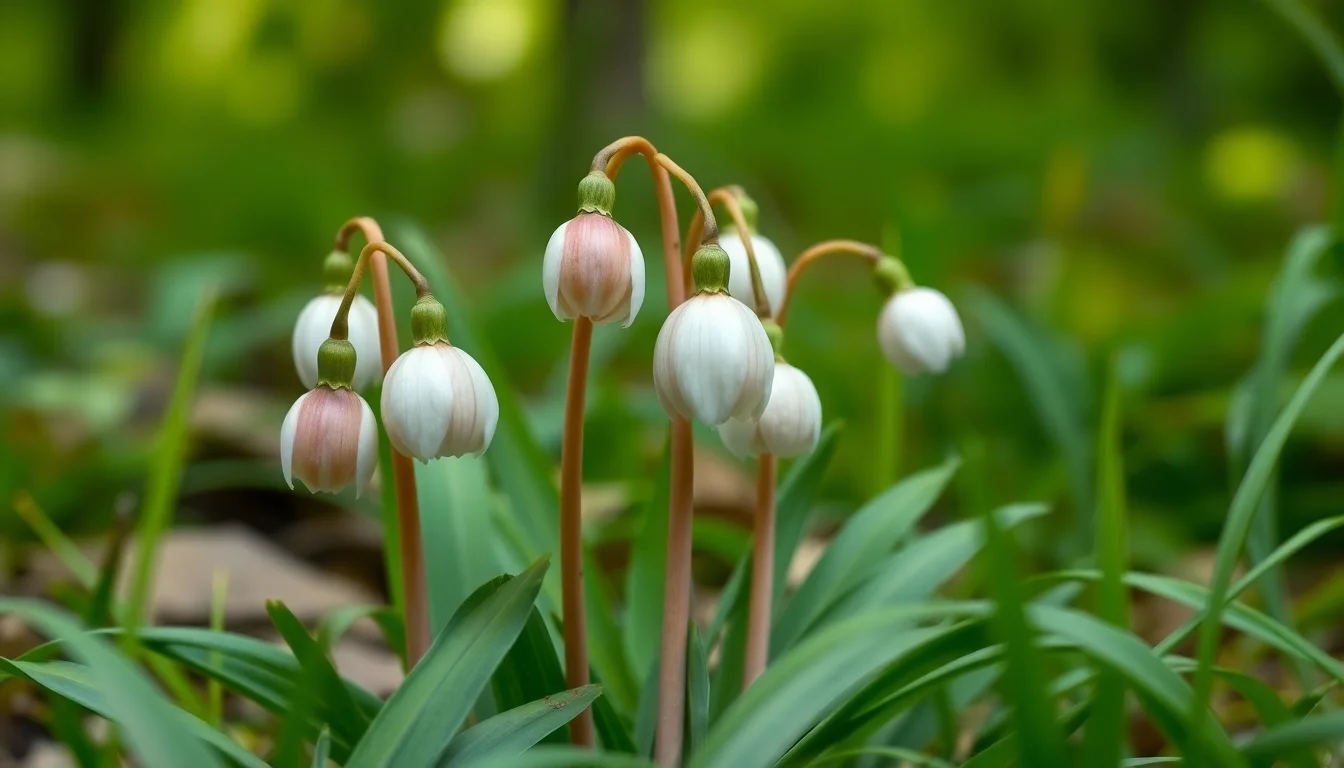
- Shape: Bell-shaped (campanulate), small, pendant. They are not open stars like wild garlic.
- Color: White (rarely pink).
- Flowering period: April-May.
- Arrangement: Flowers grow on one side of the raceme (unilateral spike), not in an umbrella shape.
Roots/Rhizomes
- Appearance: Creeping underground rhizome, highly branched. It does not have a defined bulb like garlic.
- Smell: No garlic smell.
Berries
- Shape: Small red spheres (5-7 mm diameter).
- Period: Summer-autumn.
- Toxicity: EXTREMELY TOXIC. Even a handful of berries can be fatal for a child.
Toxicity Level
☠️ TOXICITY: Lily of the valley contains over 30 cardiac glycosides, including convallatoxin. Ingestion of leaves, flowers, or berries can cause:
- Nausea, vomiting, diarrhea
- Bradycardia (slowing of heart rate)
- Cardiac arrhythmias
- Confusion, hallucinations
- In severe cases: cardiac arrest and death
>
Toxic dose for adults: Only 2-3 leaves can cause significant symptoms. Berries are even more dangerous.
>
Emergency number: In case of suspected poisoning, call 911 or your country emergency number or your nearest Poison Control Center.
4. Comparison Table: 7 Key Differences
| Characteristic | Wild Garlic ✅ (*Allium ursinum*) | Lily of the Valley ⚠️ (*Convallaria majalis*) |
|---|---|---|
| **Crushed leaf smell** | **Very strong garlic smell** | **No smell** (herbaceous/neutral) |
| **Leaves per stem** | **1 leaf** single from base | **2-3 leaves** in pairs from base |
| **Leaf shape** | Broad, lanceolate, flat | Narrower, elliptic, slightly channelled |
| **Leaf surface** | Glossy, smooth | Matte, more leathery |
| **Flowers** | **Open stars** with 6 petals, in **umbel** | **Pendant bells** in **unilateral spike** |
| **Root** | **Bulb** white, elongated | **Rhizome** creeping, branched |
| **Harvest period** | March-May (leaves), April-May (flowers) | **NEVER HARVEST** |
The #1 difference is always the smell. If you don't smell garlic, don't pick. Period.
5. Step-by-Step Guide: Identifying Wild Garlic in 5 Minutes
Step 1 — Check the Habitat
Wild garlic grows in shady, moist woodlands, often near watercourses. If you find it in a dry meadow or in full sunlight, it might not be the right spot. Lily of the valley shares the same habitat, so this step alone isn't enough — but it helps you know if you're in the right place.
Step 2 — Check the Number of Leaves
Look at the base of the plant. Wild garlic produces a single leaf per stem (growing directly from the bulb). Lily of the valley produces 2-3 leaves growing from the same point. If you see multiple leaves emerging from the base stem, stop and verify with the smell.
Step 3 — Crush and Smell (Decisive Test)
This is the most important test. Crush a leaf between thumb and forefinger, then bring your nose close.
- ✅ Strong garlic smell → It's Allium ursinum. You can proceed with harvesting.
- ❌ No garlic smell → DO NOT PICK. It could be Convallaria majalis or another species.
Tip: If you're a beginner, do the smell test on every single plant you pick, even if you're "sure." The smell doesn't lie.
Step 4 — Check the Flowers (If in Flowering Season)
If it's April-May and the plant is in flower:
- Wild garlic: Open star-shaped flowers, white, gathered in an umbrella at the tip of a bare stem.
- Lily of the valley: Bell-shaped flowers, white, pendent, arranged on one side of the raceme.
Step 5 — Verify the Root (Optional but Definitive)
If you want total confirmation, gently extract a plant and check the root:
- Wild garlic: Small white bulb, elongated, with garlic smell.
- Lily of the valley: Rhizome creeping, branched, without a defined bulb.
Golden rule: If even ONE characteristic doesn't match, don't pick. Wait, ask an expert, or take photos and compare online with reliable sources.
6. Most Common Beginner Mistakes
❌ "It looks like it, so it is"
The leaves may look similar at first glance, but the differences are clear when you know what to look for. Never trust the general appearance alone. Always use the smell test.
❌ "There's no smell, so it's safe"
Lily of the valley has no garlic smell, but that doesn't mean it's edible. The absence of garlic smell is not a confirmation of safety — it's only a signal that it's not wild garlic.
❌ "I found it in the right place"
Both plants grow in the same habitats. Being in a moist woodland is not a guarantee. The location doesn't identify the plant.
❌ "The internet said that..."
Photos online can be misleading, especially generic ones. Rely only on reliable botanical sources and, when in doubt, consult a local expert.
❌ "I ate some and I feel fine"
Symptoms of lily of the valley poisoning can appear hours after ingestion. The fact that you have no immediate symptoms doesn't mean the plant was safe.
7. What to Do If You're Unsure
🛑 DO NOT PICK. When in doubt:
>
1. Take detailed photos — leaf (front and back), flower (if present), root, general habitat
2. Consult an expert — local mycological association, botanist, or reliable foraging group
3. Use identification apps as support — not as the only source. Useful apps: iNaturalist, PlantNet (always verify with the smell)
4. Never consume a plant not identified with 100% certainty
In Case of Suspected Poisoning
- Call 911 or your country emergency number or your nearest Poison Control Center immediately
- Do not induce vomiting unless instructed by a doctor
- Bring a sample of the ingested plant (if possible)
8. Where and When to Find Wild Garlic
Optimal Period
- Leaves: March-May (best when young and tender, before flowering)
- Flowers: April-May (edible, great for garnishing dishes)
- Bulbs: September-November (after flowering, when the plant has accumulated reserves)
Habitat in Italy
| Region | Optimal Period | Typical Habitat |
|---|---|---|
| Northern Italy (Alps, Apennines) | April-June | Beech forests, mixed woods, 400-1500m |
| Central Italy (Toscana, Umbria) | March-May | Oak groves, chestnut woods, near streams |
| Southern Italy and Islands | February-April | Moist woodlands, mountain areas |
| Tuscany (Florence area) | March-May | Vallombrosa, Pratomagno, shady woods |
How to Harvest Correctly
- Pick only the leaves, not the whole plant (leave the bulb in the ground)
- Take maximum 2-3 leaves per plant to avoid compromising the population
- Use a basket or cloth bag (not plastic — it makes them wilt)
- Don't harvest near roads, treated fields, or polluted areas
- Wash thoroughly before consumption
Frequently Asked Questions (FAQ)
Can I confuse wild garlic with other toxic plants?
Yes, besides lily of the valley, wild garlic can be confused with: - Autumn crocus (Colchicum autumnale) — broader leaves, no garlic smell, toxic - Star of Bethlehem (Ornithogalum) — similar but with white veins on the leaf - Cyclamen (Cyclamen) — different leaves, no smell In all cases, the smell test resolves every doubt: if you don't smell garlic, it's not wild garlic.
Is the smell really the most reliable method?
Yes, it is the most reliable and immediate method. The garlic smell is unmistakable and cannot be imitated by any toxic plant. However, for beginners, it's advisable to combine the smell test with at least one other verification (number of leaves, shape, flowers).
What do I do if I've eaten lily of the valley by mistake?
Call 911 or your country emergency number or the Poison Control Center immediately. Don't wait for symptoms to appear. The cardiac glycosides in lily of the valley can cause dangerous arrhythmias even at relatively low doses. Bring a sample of the ingested plant with you.
Are photos on the internet reliable for identification?
Photos can be a good starting point, but they are not sufficient alone. They don't convey the smell (the most important difference) and can be mislabeled. Use photos as support, but always verify with the smell test and, if possible, with an expert.
Are there reliable apps for plant identification?
The best apps currently available are: - iNaturalist — community of experts who verify identifications - PlantNet — visual recognition with good accuracy - PictureThis — intuitive interface, good for beginners No app is infallible. Use them as a support tool, not as the sole source of identification. The smell test remains the safest method.
Can wild garlic be eaten raw?
Yes, wild garlic is excellent raw in salads, on bread, or as a seasoning. The flavor is more delicate than cultivated garlic. You can also cook it (pesto, soups, risottos), but cooking slightly reduces the vitamin C and allicin content.
How much wild garlic can I harvest?
For one person, 100-200g of fresh leaves per week is more than sufficient for culinary use. Never harvest more than 10-20% of the local population to preserve the species. ---